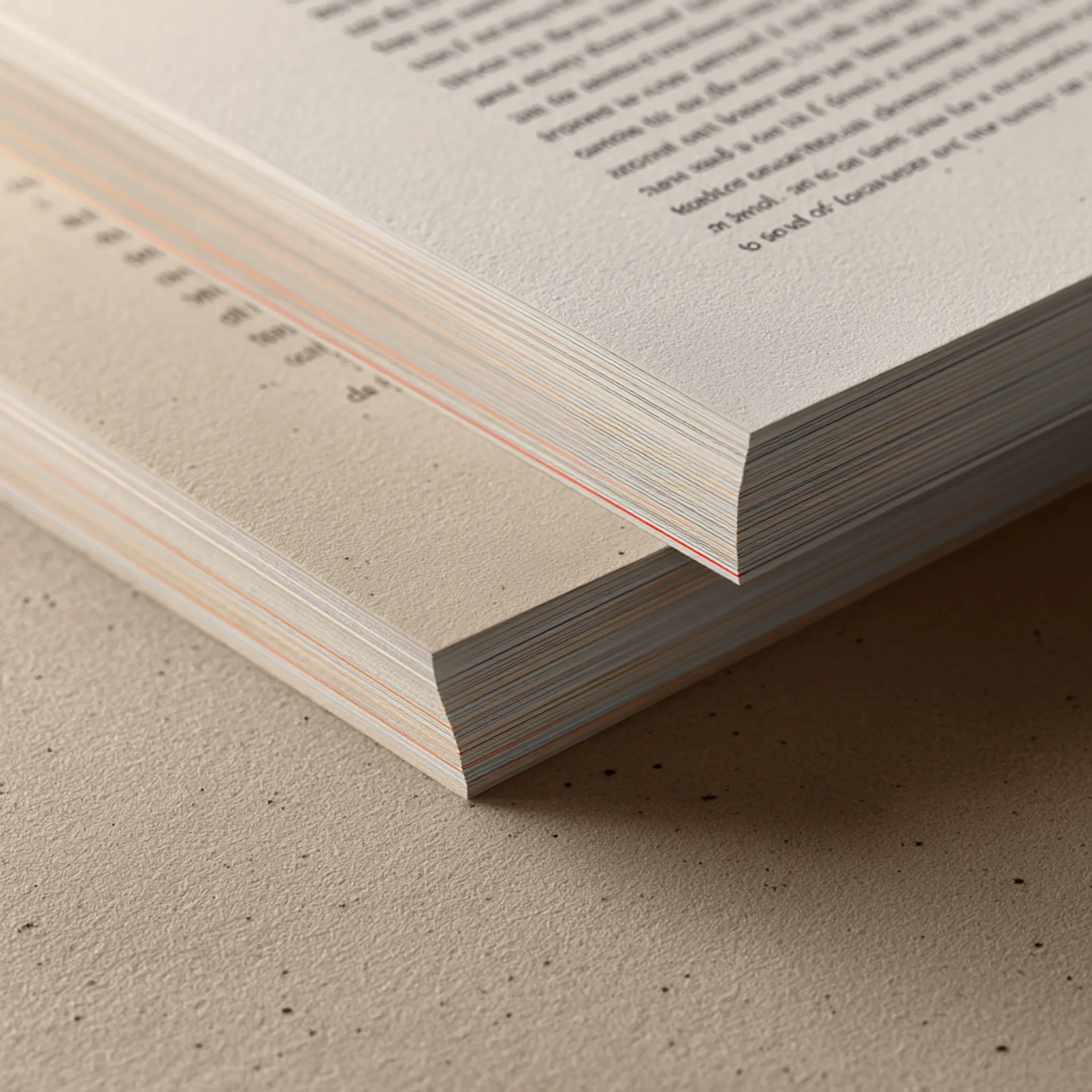
Biography & Memoir Book Printing
Hardcover heirlooms, mixed-stock photo inserts, and acid-free interiors — printed for the genre where the physical book is part of the legacy it preserves.
Built for How Biographies and Memoirs Are Actually Produced
Mixed-Stock Photo Inserts
Black-and-white text on uncoated cream with color photo sections on coated stock — bound into a single book. We manage the stock transition at the bindery so insert pages sit flush with the text block.
Archival-Grade Materials
Acid-free, lignin-free interior paper that resists yellowing and degradation. A biography built to be passed down should still be readable in fifty years — the paper stock matters as much as the binding.
Foil-Stamped Hardcovers
Case-bound hardcovers with foil on the spine and front cover — the standard presentation for biographies of public figures, institutional histories, and family legacy editions.
Archival Photo Reproduction
We calibrate press settings for the mixed-age, mixed-quality source photography that biographies rely on — scanned prints from the 1940s alongside digital captures from last year, all printing consistently on the same sheet.
Who This Page Is For
This page is for biography authors, memoirists, family historians, estate representatives, institutional publishers, and hybrid presses printing narrative nonfiction about a person’s life — in runs of 25 to 5,000 copies. Whether you are producing a trade biography of a public figure, a self-published memoir, a family history for a reunion, or an institutional tribute volume, the production guidance here applies.
Biography and memoir occupy a unique position in book manufacturing. Unlike fiction, where interiors are almost always black-and-white text on a single paper stock, biographies routinely involve mixed-stock printing — uncoated pages for the narrative, coated inserts for photographs. Unlike coffee table books, where the entire interior is high-color, biographies need to balance long-form readability with photographic reproduction quality. And unlike most genres, biographies are frequently produced as legacy objects — books intended to last decades and be passed between generations — which makes material choices (acid-free paper, sewn binding, archival adhesives) a genuine production concern rather than a marketing claim.
This page explains what actually changes in manufacturing when you print biography and memoir, where production failures happen, and how to spec your files to avoid them.
What Changes in Production for Biography and Memoir
Biography printing looks straightforward if you treat it as “long nonfiction with some photos.” It is not. The genre introduces production variables that most fiction and standard nonfiction printing does not encounter: mixed paper stocks within a single binding, archival material requirements, photographic source material that spans decades of capture technology, and a reader expectation of physical permanence.
Mixed-Stock Binding: Text and Photo Insert Integration
The defining production challenge of biography printing is mixed-stock binding — combining uncoated text pages with coated photo insert pages inside a single book.
Uncoated cream or white paper is the correct choice for long-form narrative text. It reduces eye fatigue, absorbs ink for clean type rendering, and feels like a “real book” to readers. But uncoated paper is a poor surface for detailed photographic reproduction. Ink spreads into the fiber structure, softening detail and muting color. A scanned photograph from 1962 that looks sharp on your screen will print muddy and flat on 60lb uncoated cream.
The solution is photo insert sections: 8, 16, or 32 pages of coated stock (typically 80lb or 100lb gloss or matte coated) bound into the text block at specific signature breaks. Coated paper holds ink on the surface, producing sharper detail, better tonal range, and accurate color.
The production complexity is in the binding. Insert sections must be collated into the correct position in the text block and bound alongside the uncoated signatures. The coated pages are thinner and slicker than the uncoated text stock — if the binding adhesive or sewing tension is not calibrated for the stock transition, the insert section can pull away from the text block over time, or the pages can feel loose compared to the rest of the book.
We manage this by adjusting adhesive application at the stock transition points and, for sewn hardcovers, by sewing the insert signatures with the same thread tension as the text signatures. The result is a book where the photo section feels integrated, not added.
Archival Paper and Longevity
Biographies and memoirs — especially family histories and institutional volumes — are often produced with the explicit intention of lasting generations. Standard book printing paper is adequate for retail fiction with a shelf life measured in years. It is not adequate for a book that someone’s grandchildren are meant to read.
The difference is acid content. Standard wood-pulp papers contain lignin, which breaks down over time and produces acid that yellows and embrittles the pages. Acid-free paper (pH neutral or alkaline) is manufactured to resist this degradation. It will not yellow, become brittle, or develop foxing (the brown spots that appear on aged paper) under normal storage conditions.
For biography and memoir projects where longevity matters, we use acid-free, lignin-free interior stock as the default. This is not a premium upsell — it is the correct material choice for the stated purpose of the book. We will flag it during spec confirmation if your project calls for archival stock and the initial spec does not include it.
Photographic Source Material: The Decades Problem
A biography about someone born in 1935 will include photographs spanning roughly 70–90 years of capture technology: black-and-white prints from the 1940s, Kodachrome slides from the 1960s, faded color prints from the 1980s, early digital photos from the 2000s, and high-resolution smartphone images from last year.
Each of these source types has different density, contrast, color accuracy, and resolution characteristics. If you scan them all and place them on a page without adjustment, the result is a photo section that looks inconsistent — some images too dark, some washed out, some with color casts that make skin tones look wrong.
We address this during preflight. Our prepress team normalizes photographic density and contrast across the insert section so images from different decades sit together without visual jarring. This is not aggressive retouching — it is calibration. We adjust levels, correct obvious color casts (the green shift on 1970s prints, the magenta drift on faded Kodachrome), and ensure that all images have a consistent tonal foundation. The goal is for the photo section to look intentional rather than assembled.
For projects with significant photographic content (more than 32 insert pages), we recommend a physical press proof of the photo sections specifically. Screen proofing is not reliable for evaluating photographic reproduction on coated stock, because the gamut difference between RGB and CMYK is most visible in skin tones, muted earth tones, and shadow detail — exactly the tonal range that biography photography lives in.
Hardcover Construction for Heirloom Editions
The majority of trade biographies and a significant percentage of family memoirs are printed as hardcovers. The reasons are both practical (library acquisition, durability, perceived value) and emotional (a hardcover biography signals that the subject’s story was worth preserving permanently).
Biography hardcovers require specific construction decisions:
Smyth-sewn vs. perfect-bound. Smyth-sewn case binding stitches the signatures together with thread before casing in. It is the stronger method, opens flatter, and is the professional standard for biographies above 200 pages. Perfect-bound hardcovers (notch-bound or PUR-glued) are acceptable for shorter books or cost-sensitive runs, but they will not last as long under repeated reading.
Endsheet selection. Endsheets are the pages that connect the text block to the case boards. Standard endsheets are plain white or off-white. For biography and memoir, printed endsheets add a strong design element — a timeline, a family tree, a map of locations mentioned in the narrative, or a subtle pattern that echoes the cover design. Printed endsheets cost more than blank ones, but they elevate the book from “printed object” to “crafted artifact.”
Foil stamping. Foil on the spine is the genre standard for biography hardcovers. Title and author name in gold, silver, or copper foil on a cloth or printed case communicates seriousness and permanence. Foil on the front cover — a title, a portrait outline, or a decorative element — is common for premium editions.
Typical Specs for Biography and Memoir
Trade Biography (Public Figures, Historical Subjects)
| Spec | Recommended | Notes |
|---|---|---|
| Trim size | 6 × 9 in | The dominant trim for narrative nonfiction; 5.5 × 8.5 is also common |
| Binding | Smyth-sewn case bound (hardcover) | Softcover edition for broader distribution, if offering both formats |
| Interior paper | 60lb white or cream acid-free uncoated | White for better photo contrast if images are printed inline; cream for warmer reading experience |
| Photo inserts | 80lb or 100lb gloss coated | 16 or 32 pages, bound at center or between major sections |
| Cover | Printed case with matte lamination + foil on spine | Dust jacket with matte or soft-touch lamination |
| Endsheets | Printed or colored stock | Timeline, map, or design element that extends the cover concept |
Family History / Personal Memoir
| Spec | Recommended | Notes |
|---|---|---|
| Trim size | 6 × 9 in or 8.5 × 11 in | 6 × 9 for narrative-driven memoirs; 8.5 × 11 for photo-heavy family histories |
| Binding | Hardcover (case bound) or softcover (perfect bound) | Hardcover for heirloom editions; softcover for broader family distribution |
| Interior paper | 60lb cream acid-free uncoated | Acid-free is the right default for books intended to last generations |
| Photo inserts | 80lb coated, or photos inline on text stock | Inline is simpler and cheaper; inserts produce better photographic reproduction |
| Cover | Matte lamination; optional foil on hardcover | Printed case (no dust jacket) is a clean option for family editions |
| Page count | 100–400 pages | Family histories vary widely; we have no minimum page count |
Institutional / Tribute Volume
| Spec | Recommended | Notes |
|---|---|---|
| Trim size | 6 × 9 in or 7 × 10 in | 7 × 10 gives more room for photos and sidebars without going full-page |
| Binding | Smyth-sewn case bound | Institutional volumes are built to circulate and be archived |
| Interior paper | 60lb or 70lb white acid-free uncoated | White for maximum photographic clarity |
| Photo inserts | Multiple insert sections throughout, or full-color interior | Full-color interiors printed on coated stock for photo-intensive tribute volumes |
| Cover | Cloth or leather-look case with foil stamping | No dust jacket; durable case designed for display and handling |
| Extras | Ribbon marker, custom endsheets | Small additions that signal institutional quality |
Common Mistakes We See
- All photos placed inline on uncoated stock when insert sections would serve better. Inline photos on cream uncoated will look flat and soft. If the photographs matter to the story — and in biography, they almost always do — invest in coated inserts for the primary images.
- Scanned photos at screen resolution (72–150 DPI). All images must be 300 DPI minimum at the final printed size. A photo that looks adequate on a web page will print visibly blurry. For scanned prints, scan at 600 DPI and let us downsample to 300 during prepress.
- Mixed color spaces in a single file. Cover files should be CMYK. Interior text files should be grayscale for B&W sections. Photo insert files should be CMYK. Mixing RGB and CMYK in the same PDF causes unpredictable color shifts at press.
- Photo insert sections not aligned to signature breaks. Insert sections must fall at the start or end of a 16-page or 32-page signature for proper binding. Placing a photo section at page 47 of a 300-page book creates a production problem. We will adjust insert placement during preflight if needed, but it is better to plan for signature breaks during layout.
- No caption or credit formatting standard. Biographies with 40+ photos need consistent caption formatting — typeface, size, position, credit line style. Inconsistency in captions makes the photo sections look unedited. Establish a standard before layout begins.
- Spine width calculated without accounting for insert stock. Coated insert pages have a different caliper than uncoated text pages. A 300-page biography with a 32-page coated insert does not have the same spine width as a 332-page all-uncoated book. We calculate spine width from the actual stock combination, not a page count estimate.
Preflight Checklist
Before submitting files for a biography or memoir, verify:
- Interior PDF is single-page (not spreads), with pages in sequential order
- All fonts are embedded in both the interior and cover PDFs
- Cover PDF includes 0.125” bleed on all sides and matches the spine width from our template
- Interior gutter margin is at least 0.75” (0.875” recommended for 300+ page books)
- Photo insert files are CMYK, 300 DPI minimum, on a separate PDF or clearly marked within the interior file
- Insert section page counts are multiples of 8 (8, 16, 24, or 32 pages) for proper signature binding
- All scanned photographs have been cleaned, leveled, and color-corrected before placement
- Captions and photo credits follow a consistent formatting standard throughout
- Page count is final — changes after proof approval require a new spine width calculation and cover template
- For hardcovers: endsheet art (if applicable) includes a safe zone along the hinge fold
- ISBN barcode is placed on the back cover per retail requirements
- For mixed B&W and color interiors: confirm which pages are B&W and which are color to avoid mispricing
How a Biography Project Moves Through Production
1. File Intake and Spec Confirmation
You submit interior, cover, and photo insert PDFs through our upload portal. We confirm trim size, paper stocks (text and insert), binding method, and finishing options before preflight begins.
Genre-specific checkpoint: We verify the photo insert page count aligns with signature breaks, confirm the spine width calculation accounts for the mixed stock combination, and review the paper selection for archival requirements. For hardcovers, we confirm endsheet specs and foil die details. If your interior mixes inline photos with insert sections, we map the exact page positions to ensure correct collation.
2. Preflight and Photo Proofing
Our preflight process checks resolution, bleed, margins, font embedding, and color mode. For biographies, we add a photographic review step: every placed image is checked for resolution, color mode, and tonal consistency. If your source photographs span multiple decades — as most biographies’ do — we normalize density and correct color casts so the images reproduce consistently across the insert section.
You receive a digital proof for approval. For photo-heavy biographies, we strongly recommend a physical press proof of the photo insert section specifically (adds 3–5 business days). Photographic reproduction on coated stock is difficult to evaluate on screen because the gamut compression from RGB to CMYK is most visible in skin tones and muted earth tones — exactly where biography photography lives. The press proof is printed on your actual insert stock, so the proof you approve is the result that ships.
Genre-specific risks: Low-resolution scanned photos flagged during preflight. Old photographs scanned from prints (rather than from negatives or slides) often arrive at marginal resolution. We flag anything below 250 DPI and recommend rescanning at 600 DPI where possible.
3. Binding and Finishing
Softcovers go through PUR perfect binding, three-knife trimming, and lamination. Turnaround for softcover-only orders is typically 10–12 business days from proof approval. If the interior includes coated inserts, allow an additional 2–3 business days for collation.
Hardcovers are Smyth-sewn (or notch-bound for shorter runs), cased in, and pressed. Endsheets are tipped and foil is stamped before casing. Dust jackets are printed and applied separately. Hardcover turnaround is typically 15–20 business days from proof approval, depending on finishing complexity and insert collation.
Genre-specific risks:
- Insert section pull-away. Coated pages bound into an uncoated text block can delaminate over time if the adhesive is not calibrated for the stock transition. We adjust adhesive application at insert signature boundaries and verify adhesion during quality checks.
- Photo color shift under lamination. Matte lamination slightly desaturates and warms photographic cover images. Gloss lamination adds contrast and saturation. For biography covers featuring a portrait photograph, the lamination choice visibly affects how the subject looks. We recommend matte for painted or illustrated covers and request a press proof for photographic covers on either lamination.
4. Packaging and Fulfillment
Finished books are shrink-wrapped in packs of 5 or 10, then boxed. Hardcovers with dust jackets are individually wrapped to prevent jacket scuffing in transit.
We ship to your address, your distributor, or multiple locations. For family memoirs being distributed at reunions, events, or through community groups, we can pack in custom quantities and ship to multiple addresses in a single order.
Genre-specific consideration: Biography and memoir authors frequently need split shipments — 50 copies to the author, 100 to a distributor, 25 to a local bookstore for a launch event. We handle multi-destination shipping at order time. If you are doing a book launch event, work backward from that date and add 5 business days of buffer.
Design and File Preparation
Cover Design by Category
Biography covers serve a different function than fiction covers. A fiction cover sells a mood and a genre signal. A biography cover establishes the subject’s identity, the book’s seriousness, and the intended audience. Getting the visual register wrong — too casual for an institutional biography, too formal for a personal memoir — mispositions the book before anyone reads the flap copy.
Trade biography (public figures, historical subjects): Photographic covers dominated by a strong portrait of the subject. Clean, authoritative typography — typically serif. Dark or neutral backgrounds. Dust jacket with matte lamination. The design says “this person’s story is significant and the book treats it seriously.”
Literary memoir: More design-forward than trade biography. May use illustration, abstracted photography, or typographic covers. Softer palettes, textured backgrounds, handwritten or modern serif fonts. The design signals “this is a personal, reflective book” rather than “this is a historical record.”
Family history / private memoir: Simpler covers that often incorporate a family photograph or a meaningful image (a house, a landscape, an heirloom). Typography is clean but not necessarily designed by a professional.
Institutional / tribute volume: Formal, restrained design. Often a photograph of the subject or institution, the organizational logo, and conservative typography. Cloth or leather-look case materials are common. The design should look appropriate on a shelf in a boardroom, a university library, or a memorial display.
Interior Formatting
Biography and memoir interiors follow narrative nonfiction conventions, with a few genre-specific additions:
- Font: Serif typeface, 11–12pt, with comfortable leading. Garamond, Caslon, Minion Pro, and Palatino are common. Avoid decorative fonts for body text — readability across 300+ pages is paramount.
- Margins: 0.75–1” on all sides, with the gutter margin increased to 0.875–1” for books over 250 pages.
- Chapter openings: Drop caps, small caps on the first line, or a simple centered chapter title. Biographies often include a date range or location subtitle under the chapter title to orient the reader in the subject’s timeline.
- Photo captions: Consistent typeface (typically the body font in italic or a smaller size), consistent placement (below or beside the image), and a consistent credit format. Establish this standard before layout.
- Footnotes/endnotes: Trade biographies frequently include extensive source notes. Endnotes are the standard for biographies (as opposed to footnotes) because they keep the text pages clean. Format endnotes by chapter with a clear reference system.
- Front matter: Half title, title page, copyright page, dedication, table of contents (optional but common for longer biographies), acknowledgments (sometimes placed in back matter), map or timeline (if applicable).
- Back matter: Source notes, bibliography, index (for trade biographies), about the author, photo credits.
For authors preparing files independently, we provide templates and a spine width calculator that accounts for mixed-stock inserts. Full specs are in the file preparation guide.
Spec Downloads and Tools
We provide production tools designed for biography and memoir printing workflows:
- Cover template generator — Enter your page count, text stock, and insert stock, and get a cover template with exact spine width, bleed marks, and safe area guides. The spine calculation accounts for mixed-stock combinations. Available as PDF and Adobe Illustrator files.
- Spine width calculator (mixed-stock mode) — Calculate spine width when your book combines uncoated text pages with coated insert pages. Standard spine calculators assume a single stock — ours does not.
- Photo insert planning guide — Signature-break reference showing where insert sections can be placed in your book, based on page count and text stock. Helps you plan photo placement during the writing and layout stages, not after.
- Scanning guide for archival photos — Resolution, color mode, and file format recommendations for scanning prints, slides, and negatives for book reproduction. Includes guidance on handling fragile originals.
- Paper sample kit — Request physical samples of our acid-free cream and white uncoated stocks, plus the coated insert stocks in gloss and matte. See and feel the actual papers before committing.
These tools are available in our Resources section. Designers and authors who work with our templates submit production-ready files at a higher rate, which means fewer preflight revisions and faster turnaround.
Trust Signals
Production volume: Origin Books prints biographies, memoirs, autobiographies, family histories, and institutional tribute volumes for indie authors, estate representatives, hybrid publishers, university presses, and organizations. Our biography production ranges from 25-copy family memoirs to 5,000-copy trade biographies with national distribution.
Mixed-stock bindery capability: Photo insert collation, mixed-stock binding, and stock-transition adhesive calibration are performed in-house. This is the production step where most biography printing fails at other shops — insert sections that pull away, coated pages that feel loose, uneven trim on mixed-caliper signatures. We control the entire process in our own bindery.
Archival materials: We stock acid-free, lignin-free interior papers as a standard option, not a special order. For projects where longevity is the stated goal, we default to archival stock and flag it during spec confirmation if it is missing from the initial order.
Photographic prepress: Our prepress team normalizes mixed-era photography for consistent reproduction. We do not simply place your files on the press sheet — we evaluate and adjust every image in the photo insert section for density, contrast, and color accuracy.
Finishing equipment: Kluge foil stamping press, UV coating line, and three-knife trimmer with digital measurement — the same bindery equipment used by trade publishers for hardcover nonfiction.
For the full selection of paper options, binding methods, and finishing techniques, see Paper and Materials and Binding Options.
Next Steps
Ready to print? Request a quote with your trim size, page count, insert section details, quantity, and finishing preferences. If your project includes photo inserts, note the number of color pages so we can quote the mixed-stock configuration accurately.
Need templates? Download cover templates with mixed-stock spine calculations to prepare production-ready files.
Have production questions? Talk to our production team — not a sales team. You will speak with someone who understands bindery, paper, photographic reproduction, and press.
Biography & Memoir Printing — Production FAQ
Why do scanned family photos look different in print than on screen?
Monitors display images using RGB light, which has a wider color gamut than CMYK ink on paper. Old photographs also carry color casts — sepia tones, blue shadows from aging chemistry — that screens compensate for but print reproduces literally. We adjust scanned photos during preflight: correcting color casts, boosting contrast lost in scanning, and normalizing density so a 1955 print and a 2020 digital photo look intentional next to each other on a coated insert page. If your photos vary widely in quality, we recommend a physical press proof so you can see the final reproduction before the full run.
What is the difference between photos printed inline versus on insert pages?
Inline means the photos print on the same paper stock as the text — typically 60lb cream uncoated. Photos will be softer, with less contrast and color saturation, because uncoated paper absorbs ink differently than coated stock. Insert pages are printed separately on 80–100lb coated stock, which holds fine detail, produces sharper images, and supports full-color reproduction. Inserts are then bound into the text block at designated signatures. For biographies with important photographic content — especially historical images where detail matters — inserts on coated stock are the professional standard.
Can I include a mix of black-and-white and color photos?
Yes. The most common approach for biographies is black-and-white photos printed inline on the text stock (at no additional cost over B&W printing) plus one or two color insert sections on coated paper. The color inserts are typically grouped — a 16-page or 32-page photo section placed at the center of the book or between major sections. We can also scatter individual color pages throughout the book, but this adds cost because each color page requires a separate press setup or a hybrid digital/offset workflow.
What if I only need 25–50 copies for my family?
We welcome small orders — many memoir authors start with exactly this range. At 25–50 copies, all printing is digital, which means no plate charges and no minimum signature requirements for photo inserts. The unit cost is higher than at 250 or 500 copies, but the total investment is modest. We can also hold your files for reprint at any time, so you can order another 25 copies for a reunion or anniversary without repeating the setup process. Use the pricing calculator at /contact for exact per-copy cost at any quantity.
Do you offer hardcover with a dust jacket?
Yes. A case-bound hardcover with a printed dust jacket is the classic biography format — it is what readers expect when they pick up a biography in a bookstore or library. We print the dust jacket on 100lb gloss or matte text stock with lamination, and the case beneath can be plain cloth, printed, or foil-stamped. For family memoirs and private editions, a printed case without a dust jacket is also a strong option — it is more durable and gives the book a cleaner, more personal feel.
Why does my hardcover biography cost significantly more than a softcover?
Hardcover case binding is a multi-step process that involves separate materials and labor: the case boards are cut and wrapped, the text block is sewn or adhesive-bound, endsheets are tipped in, and the text block is cased in and pressed. A dust jacket adds another printed and laminated component. At 100 copies, a hardcover biography typically costs 2–3x the softcover price for the same interior. The premium narrows at higher quantities because the per-unit labor cost decreases. For biographies intended as heirloom or library copies, the durability and presentation justify the difference.