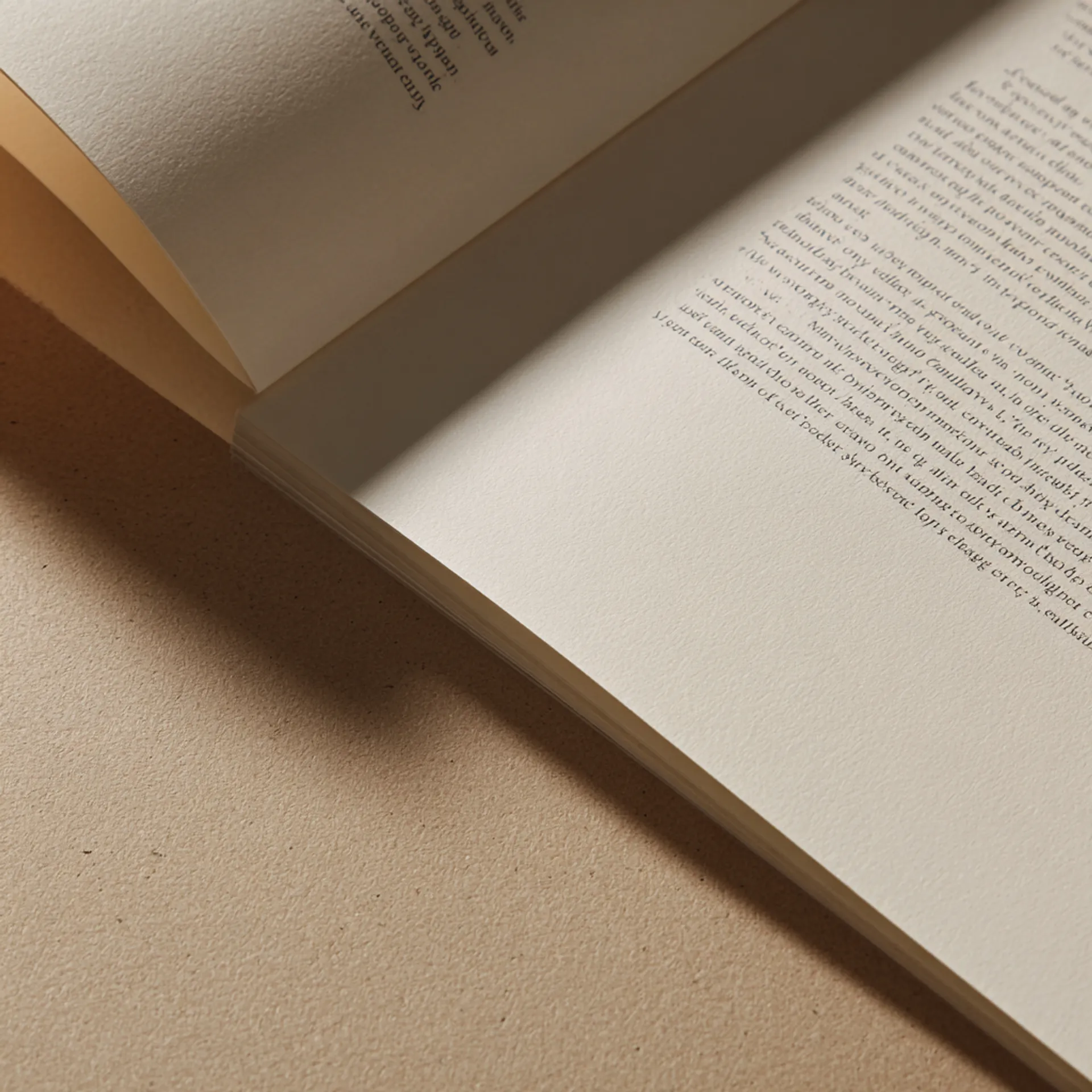
Religious & Spiritual Book Printing
Bible-weight paper for high-page-count texts, gilt edges, multi-ribbon markers, and leather-look covers — printed for the category where the physical book is part of the devotional experience and the finishing signals the significance of the content.
Built for How Religious Texts Are Actually Produced and Used
Bible-Weight Paper for High Page Counts
Lightweight, high-opacity Bible paper (30lb–40lb) allows texts of 800–1,500 pages to bind into a single volume that is portable, durable, and readable — without show-through compromising the text on the reverse side.
Gilt, Stained, and Decorative Edges
Gold gilt, silver gilt, and colored stained edges applied to the trimmed text block — the finishing detail that has signaled the importance of religious texts for centuries and that readers continue to expect.
Multi-Ribbon Markers and Thumb-Index Tabs
Two, three, or four sewn-in ribbon markers in coordinated colors for navigating between books, chapters, and daily readings. Die-cut thumb-index tabs for direct access to specific sections of scripture or reference material.
All Faith Traditions
We print texts for Christian, Jewish, Muslim, Buddhist, Hindu, Sikh, and nondenominational spiritual communities. The production requirements vary by tradition — we understand the specific formatting conventions, right-to-left typesetting needs, and finishing expectations of each.
Who This Page Is For
This page is for religious publishers, congregations, faith-based organizations, denominational presses, independent authors of spiritual literature, pastors producing study materials, and organizations of any tradition printing Bibles, scripture texts, devotionals, prayer books, hymnals, study guides, catechisms, liturgical texts, and spiritual nonfiction in runs of 25 to 5,000 copies. The production guidance here applies across Christian, Jewish, Muslim, Buddhist, Hindu, Sikh, and nondenominational traditions.
Religious book printing spans a wider range of production complexity than any other single genre category. At one end, a congregational devotional is a straightforward softcover book — 200 pages, cream paper, matte cover. At the other end, a leather-bound Bible with gilt edges, thumb-index tabs, four ribbon markers, two-column text on Bible-weight paper, and a presentation page is one of the most production-intensive objects in all of book printing. Between those endpoints are hymnals with musical notation, study Bibles with multi-layered reference layouts, prayer books with liturgical calendars, and spiritual titles that function like trade nonfiction.
This page explains what changes in manufacturing across this range, where production failures occur for each format, and how to spec religious books correctly.
What Changes in Production for Religious Books
Religious book production introduces three categories of manufacturing challenge that other genres rarely encounter: extreme page counts on lightweight paper (Bibles and scripture texts), specialty finishing that is standard rather than optional (gilt edges, ribbon markers, thumb tabs), and complex reference layouts that demand precision typesetting and presswork. Each of these requires specific production knowledge.
Bible-Weight Paper and High Page Count Engineering
The defining production challenge of scripture printing is page count. A complete Bible contains approximately 780,000 words. Set in a readable two-column layout at standard type sizes, that is 1,200–1,500 pages. A Quran in Arabic with parallel English translation runs 600–900 pages. Comprehensive prayer books, liturgical texts, and annotated study editions routinely exceed 800 pages.
Printing this many pages on standard 60lb book paper produces a book that is impractically thick and heavy — 2.5–3 inches thick, weighing 3–4 pounds, impossible to hold comfortably during a service or extended reading. Bible paper solves this problem.
What Bible paper is. A lightweight stock (typically 30lb–40lb, compared to 60lb standard book paper) manufactured to be thin, opaque, and durable. The thinness allows high page counts to bind into a portable volume — a 1,200-page Bible on 36lb Bible paper is roughly 1–1.25 inches thick and light enough to hold in one hand. The opacity prevents the text from the reverse side showing through, which is critical for two-column scripture text where dense type on both sides of the sheet would be unreadable if the paper were transparent.
Opacity engineering. Opacity in lightweight paper is achieved by adding mineral fillers (titanium dioxide, calcium carbonate) to the paper pulp during manufacturing. These fillers scatter light within the sheet, blocking the transmission of images from the reverse side. The tradeoff is that fillers can reduce paper strength — over-filled paper becomes brittle and tears easily. High-quality Bible paper balances opacity with fiber integrity so the pages are thin and opaque but also flexible enough to turn without tearing and strong enough to survive years of daily handling.
Show-through verification. Even with high-opacity Bible paper, some show-through is inherent at these paper weights. The question is whether the show-through interferes with readability. We verify show-through on a sample sheet before production — printing a representative page of two-column text on both sides and evaluating the ghosting under standard reading light. If show-through exceeds an acceptable threshold, we recommend a heavier Bible paper weight or a different stock within the lightweight range.
Spine width on lightweight stock. Bible paper has a very low caliper per sheet, which means the spine width per page is small. A 1,200-page Bible on 36lb stock may have a spine of only 1.1–1.3 inches. Spine width must be calculated from the actual measured caliper of the paper lot, not from a generic formula, because caliper varies between mill lots on lightweight stock. We measure every incoming Bible paper delivery and calculate spine width from the measured value.
Binding lightweight pages. Bible-weight paper is more difficult to bind than standard book paper. The thin sheets are more prone to tearing at the sewing or adhesive line, and the high page count concentrates more stress on the binding. Smyth sewing is mandatory for Bible-weight texts because the thread distributes stress across the signature rather than concentrating it at an adhesive line. EVA or PUR adhesive binding on Bible paper will fail — the thin pages pull free from the glue within months of regular use.
Specialty Finishing: Gilt Edges, Ribbons, and Thumb Tabs
Religious books carry a set of finishing expectations that are standard for the category but rare in other genres. These are not premium upgrades — for Bibles, prayer books, and gift editions, they are the expected presentation.
Gilt edges. Gold (or silver) applied to the three trimmed edges of the text block — top (head), bottom (tail), and fore-edge. Gilt edges serve a dual function: they protect the page edges from dust, dirt, and moisture (the sealed metallic surface prevents particulate from entering between the pages), and they signal the significance of the text. Gilt edges also make the book easier to fan and navigate because the smooth metallic surface reduces friction between pages.
Genuine gold gilt uses gold leaf applied and burnished by hand. It is the most durable and visually rich option — the gold does not tarnish, chip, or discolor. Imitation gilt uses metallic foil applied under heat and pressure. It is less expensive and visually similar but less durable — the foil can dull and wear with repeated handling. Colored edge staining (red, blue, green, or custom colors) is an alternative to gilt and is common for prayer books, devotionals, and editions where a specific color complements the cover design.
Ribbon markers. Sewn-in fabric ribbons attached to the headband of the spine, long enough to extend below the text block. Religious texts frequently require multiple ribbon markers — a Bible used in daily devotion might need three or four ribbons to mark the current reading in the Old Testament, New Testament, Psalms, and a daily reading plan simultaneously. Each ribbon is a different color for easy identification. Ribbons are attached during the binding process and must be long enough to reach the bottom of the text block with slack to spare. For Bibles on lightweight paper (thin text blocks), ribbon length requires careful specification — a ribbon that is too short does not reach the bottom; too long, and it bunches below the text block.
Thumb-index tabs. Die-cut semi-circular tabs on the fore-edge of the text block, each labeled with a book name (Genesis, Exodus, Psalms, Matthew, etc.) for direct access. Thumb tabs are cut after the text block is trimmed, and the labels are printed on the exposed step of each tab. The production consideration is that each tab removes a small amount of paper from the page edge, which is visible on the pages that are cut. On Bible-weight paper, the tab cut must be precise — too aggressive and the thin paper tears; too shallow and the tab is not distinct enough to feel with a thumb.
Presentation pages. A printed page at the front of the book with spaces for the owner’s name, dates (birth, baptism, confirmation, marriage, ordination), and a dedication. Presentation pages are standard in gift Bibles, prayer books, and commemorative editions. They are printed as part of the front matter but may use a different layout or paper stock (heavier stock, different color) than the interior.
Leather-look covers. Bonded leather, PU (polyurethane) leather, or genuine leather case wraps on hardcover editions. Leather-look covers are the standard for premium Bibles and prayer books — they are soft, flexible, durable, and feel appropriate for texts that are carried and handled daily. Foil stamping (typically gold) on the cover and spine is standard on leather-look editions: title, cross or tradition-specific symbol, and any subtitle or edition identifier.
Complex Reference Layouts
Religious reference texts — study Bibles, annotated scriptures, concordances, liturgical calendars — use some of the most complex page layouts in publishing. A study Bible page may contain the scripture text in two columns, cross-references in a margin column, footnotes at the bottom, a running header with the book and chapter, and supplementary notes in a sidebar. Each element must be typographically distinct, correctly positioned, and legible at small type sizes on thin paper.
Two-column scripture text. The standard layout for Bibles and long religious texts. Two columns allow more text per page (reducing total page count) and produce shorter line lengths that are easier to read in the small type sizes required for high-page-count texts. Column width, gutter between columns, and margin proportions must be consistent throughout the text.
Cross-references and footnotes. Study Bibles include cross-references (links to related passages) and footnotes (translation notes, commentary, textual variants). These are set in smaller type below the scripture text or in a dedicated reference column. The critical production requirement is that cross-reference markers in the scripture text align with the corresponding entries in the reference apparatus — misalignment between a superscript marker and its footnote is a content error, not just a layout error.
Musical notation in hymnals. Hymnal pages contain staff notation (five-line staff with notes, rests, key signatures, time signatures, and dynamics) above or beside the lyric text. Musical notation is a complex graphical element that requires 600–1200 DPI for clean reproduction — noteheads, stems, beams, and ledger lines are fine details that degrade at lower resolution. We verify notation resolution during preflight and also check for common typesetting artifacts: broken staff lines, misaligned noteheads, and beam rendering errors that can occur when music notation software exports to PDF.
Right-to-left layouts. Arabic, Hebrew, and Urdu religious texts read right to left. The entire book structure is mirrored: the book opens from the left side (what English readers would consider the back), the spine is on the right when the cover faces the reader, and the gutter margin is on the right side of each page. Cover templates, page imposition, and bindery setup must all be configured for RTL production. We produce RTL books regularly and verify the full production chain during preflight.
Typical Specs for Religious Books
Bible / Scripture Text
| Spec | Recommended | Notes |
|---|---|---|
| Trim size | 5.5 × 8.5 in or 6 × 9 in | 5.5 × 8.5 for portable editions; 6 × 9 for study editions with wider margins |
| Binding | Smyth-sewn case bound | Mandatory for Bible-weight paper; must survive years of daily use |
| Interior paper | 30lb–40lb Bible paper (India paper) | Weight depends on total page count; verify opacity before production |
| Cover | Leather-look (PU or bonded leather) with gold foil | Flexible cover that conforms to the hand; foil on title, spine, and tradition symbol |
| Interior color | B&W or B&W with red letter (words of Christ in red) | Red-letter editions require a two-color press run (black + red) |
| Page count | 800–1,500 pages | Bible paper makes these counts practical in a single volume |
| Extras | Gilt edges, 2–4 ribbon markers, thumb-index tabs, presentation page | These are standard finishing for Bibles, not premium add-ons |
Devotional / Prayer Book
| Spec | Recommended | Notes |
|---|---|---|
| Trim size | 5 × 7 in, 5.5 × 8.5 in, or 4.25 × 6.75 in (pocket) | Smaller trims for devotionals carried in purses or pockets |
| Binding | Smyth-sewn hardcover or PUR softcover | Hardcover for gift editions and daily-use prayer books; softcover for broader congregational distribution |
| Interior paper | 60lb cream uncoated | Cream for warm reading feel; acid-free for devotionals intended as keepsakes |
| Cover | Leather-look with foil (hardcover) or matte lamination (softcover) | Foil cross or tradition symbol on hardcover editions |
| Interior color | B&W | Color for devotionals with interior illustrations or photographs |
| Page count | 100–400 pages | Daily devotionals (365 entries) typically 300–400 pages |
| Extras | 1–2 ribbon markers, gilt or stained edges on hardcover editions | Single ribbon standard; gilt edges for gift editions |
Hymnal / Songbook
| Spec | Recommended | Notes |
|---|---|---|
| Trim size | 6 × 9 in or 7 × 10 in | Larger trim accommodates musical notation alongside lyrics |
| Binding | Smyth-sewn case bound | Hymnals are used weekly for years; must survive constant pew-back handling |
| Interior paper | 60lb or 70lb white uncoated | White for maximum contrast on musical notation; 70lb for resistance to page flex and tearing |
| Cover | Buckram cloth or printed case with matte lamination | Buckram is the traditional hymnal cover — extremely durable, stain-resistant, available in liturgical colors |
| Interior color | B&W | Musical notation and text in black only |
| Page count | 400–800 pages | Comprehensive hymnals are long; section breaks by liturgical season or theme |
| Extras | Ribbon markers, hymn-number index, first-line index, scripture index | Multiple indices are standard for hymnals |
Study Guide / Catechism / Course Material
| Spec | Recommended | Notes |
|---|---|---|
| Trim size | 6 × 9 in or 5.5 × 8.5 in | Standard book trims for study materials |
| Binding | PUR softcover or Wire-O | Softcover for standard study guides; Wire-O for workbooks with fill-in exercises |
| Interior paper | 60lb cream or white uncoated | White for study guides with charts and diagrams; cream for text-heavy catechisms |
| Cover stock | 12pt C1S with matte lamination | Clean, professional cover signaling institutional authority |
| Interior color | B&W standard; color for illustrated study materials | |
| Page count | 80–300 pages |
Common Mistakes We See
- Standard 60lb paper used for a 1,000+ page text. The resulting book is too thick and too heavy. Bible paper (30lb–40lb) is required for texts above approximately 600 pages. We flag page count vs. paper weight mismatches during spec confirmation.
- PUR or EVA adhesive binding on Bible-weight paper. Adhesive binding on thin paper fails within months of daily use — the pages pull free from the glue line because the thin sheets provide insufficient surface area for adhesive grip. Smyth sewing is mandatory for Bible-weight stock.
- Musical notation at 300 DPI or below. Staff lines, noteheads, stems, and beams require 600 DPI minimum for clean reproduction. At 300 DPI, notation prints with visible stair-stepping on thin lines, and small noteheads become indistinct. Export hymnal pages at 1200 DPI where possible.
- Ribbon markers specified too short for the text block. Ribbons must extend below the bottom of the text block by at least 1–2 inches when the book is closed. For Bible-weight texts with narrow spine widths, the ribbon length can be deceptively short — measure from the headband, through the full page height, to below the text block.
- Thumb-index tabs not aligned to content. Each thumb tab must align precisely with the first page of the book or section it labels. If the tab position drifts even a few pages, the reader navigates to the wrong location. We position tabs based on the final page layout, not an estimate.
- Red-letter text specified without a two-color press setup. Red-letter editions (words of Christ in red type) require a two-color press run — black plus a specified red (typically PMS 185 or similar). This cannot be achieved by converting black text to a CMYK red in a single pass without registration drift. The red text must be on a separate plate.
- RTL text submitted with LTR page order. Right-to-left religious texts must be submitted with pages in the correct RTL reading order, with mirrored margins and a mirrored cover template. Submitting an RTL text in LTR order requires the entire file to be reconfigured. We verify page order and reading direction during preflight.
- Gilt edges ordered on a book with untrimmed or rough-cut edges. Gilt can only be applied to smooth, trimmed edges. If the book design calls for deckle (rough-cut) edges on two sides with gilt on the third, the gilt and deckle specifications must be coordinated. Most religious books use smooth-trimmed edges on all three sides.
Preflight Checklist
Before submitting files for a religious book:
- Interior PDF is single-page (not spreads), pages in correct reading order (LTR or RTL as appropriate)
- All fonts embedded — including specialty fonts for Hebrew, Arabic, Greek, and other non-Latin scripts
- Musical notation (hymnals) at 600 DPI minimum, preferably 1200 DPI
- All cross-reference markers match their corresponding footnote/reference entries
- Cover PDF includes 0.125” bleed on all sides; spine width calculated from actual Bible paper caliper if applicable
- Interior gutter margin appropriate for the binding method and page count (0.875” minimum for Smyth-sewn texts over 400 pages)
- For RTL texts: page order verified as RTL; margins mirrored; cover template mirrored
- For red-letter editions: red text on a separate color plate/layer; red PMS color specified
- Thumb-index tab positions mapped to the first page of each labeled section
- Ribbon marker count, colors, and length specified
- Gilt edge specification: genuine gold, imitation gilt, or colored stain; which edges (typically all three)
- Presentation page layout finalized (if included)
- ISBN barcode on back cover for retail distribution
- For hymnals: hymn number index, first-line index, and scripture index verified against content
How a Religious Book Project Moves Through Production
1. File Intake and Spec Confirmation
You submit interior and cover files through our upload portal. We confirm trim size, paper stock (standard or Bible-weight), binding method, cover material, finishing options (gilt, ribbons, tabs), and quantity. For hymnals and study Bibles with complex layouts, we assess the layout complexity before quoting preflight time.
Genre-specific checkpoint: We verify paper weight against page count — flagging any combination where the book will be impractically thick or heavy. For Bible-weight stock, we confirm opacity with a sample print. For RTL texts, we verify page order and cover template orientation. For red-letter editions, we confirm the red text is on a separate plate. For hymnals, we check notation resolution. For leather-look covers, we confirm the material, foil color, and die artwork.
2. Preflight and Proofing
Preflight checks font embedding (critical for non-Latin scripts), resolution, margins, and page order. For religious reference texts, we also verify cross-reference accuracy on a sample basis and check two-column layout alignment. For hymnals, we verify notation resolution on every page.
You receive a digital proof for layout and text review. For leather-look covers with foil, we recommend a physical proof (adds 3–5 business days) — foil appearance on leather and bonded leather materials varies significantly from how it appears on paper, and the proof lets you evaluate the actual material-and-foil combination.
Genre-specific risks: Non-Latin font substitution (the correct Hebrew, Arabic, or Greek characters replaced by a similar but incorrect glyph). Notation resolution below threshold on hymnal pages. Cross-reference misalignment in study Bibles. Red-letter text misregistration in two-color editions.
3. Binding and Finishing
Smyth-sewn case binding: Signatures sewn, endsheets tipped, text block cased into the cover boards. For Bibles on lightweight paper, sewing tension is calibrated for the thin sheets to prevent tearing. Turnaround is 15–20 business days from proof approval.
Gilt edge application: Applied after the text block is trimmed and bound but before casing-in. The edges are sanded, sealed, and gilded (genuine gold leaf or imitation foil), then burnished. Adds 3–5 business days.
Thumb-index tab cutting: Die-cut after the text block is bound and trimmed. Each tab is cut to the position mapped during preflight. Tab labels are printed on the exposed step. Adds 2–3 business days.
Ribbon marker attachment: Ribbons are attached to the headband during the casing-in process. Multiple ribbons are layered — the longest at the bottom, the shortest on top — so they spread across the fore-edge and are individually accessible.
Leather-look cover and foil: Leather material is cut and wrapped around the case boards. Foil is stamped on the wrapped case. Foil registration on flexible leather-look material requires higher press temperature and slower stamping speed than foil on paper-wrapped cases.
Genre-specific risks:
- Gilt edge flaking on Bible-weight paper. Thin pages can shift slightly during the gilt application process, causing the gold or foil to not fully seal between pages. We compress the text block under controlled pressure during gilding to minimize page shift.
- Ribbon detachment. Multiple ribbons concentrated at the headband create a thicker attachment point. If not properly secured during casing-in, the outer ribbons can pull free. We attach each ribbon individually to the spine super cloth.
- Leather-look cover foil adhesion. Foil on textured leather-look material requires higher temperature than foil on smooth paper. We run test impressions on the actual material before the production run.
4. Packaging and Fulfillment
Bibles and premium religious books are individually wrapped to protect gilt edges, leather-look covers, and foil. Gift editions may include a rigid box or presentation sleeve.
We ship to your address, your bookstore, your congregation, your distributor, or multiple locations. For church orders distributing to members, we can pack in custom quantities.
Genre-specific consideration: Many religious book orders are gift-driven — confirmation gifts, baptism gifts, ordination gifts, holiday gifts. If your order is timed to a specific liturgical date (Easter, Christmas, Passover, Eid, ordination ceremonies), work backward from that date and add 7–10 business days of buffer for orders with gilt edges and thumb tabs.
Design and File Preparation
Typography for Religious Texts
Religious text typography has conventions that vary by tradition, text type, and reading context. Scripture texts use different typographic systems than devotionals, which use different systems than hymnals.
Scripture text. Two-column setting at 8–10pt with verse numbers inline or in the margin. The type must be legible at small sizes on thin, slightly off-white Bible paper. Serif typefaces with moderate x-heights and open counters are standard — they remain readable at small sizes without blurring. Common choices include Minion Pro, Adobe Garamond, and specialty Bible typefaces designed for small-point scripture setting. Avoid typefaces with very thin hairlines, which can break up on Bible-weight paper.
Devotionals and prayer books. Single-column setting at 10–12pt. More generous margins and leading than scripture texts because the reading pace is slower and more reflective. Chapter or daily entry divisions clearly marked.
Hymnals. Musical notation generated from a notation application (Sibelius, Finale, MuseScore, LilyPond) and exported as high-resolution PDF (600–1200 DPI). Lyric text set below the staff in a readable size (9–10pt). Hymn numbers prominently displayed for easy navigation during services. Page layout must consider turn-over practicality — a hymn that starts on a verso (left) page and ends on the next recto (right) page requires one page turn mid-hymn. Minimize these by adjusting the layout to start multi-page hymns on recto pages where possible.
Non-Latin scripts. Hebrew, Arabic, Greek, Urdu, Hindi, Chinese, and other non-Latin scripts require fonts specifically designed for those scripts — embedded in the PDF. Font substitution on non-Latin characters produces incorrect glyphs more frequently than on Latin characters because the fallback fonts in PDF rendering engines often lack the correct characters. We verify non-Latin character rendering during preflight.
Cover Design by Category
Bibles and scripture texts. Leather-look covers with gold foil on the title, spine, and a tradition-specific symbol (cross, Star of David, crescent, Om, etc.). Restrained, dignified design. The cover material and foil quality are the primary design signals.
Devotionals and prayer books. Range from leather-look hardcovers (for gift and premium editions) to softcovers with illustrated or photographic covers. Design should communicate the spiritual tone — contemplative, joyful, scholarly, or devotional — through color, typography, and imagery appropriate to the tradition.
Hymnals. Buckram cloth covers in liturgical colors (red, blue, green, purple, white) with gold foil on the title and spine. Institutional, durable design intended to match pew furnishings and last for decades of weekly use.
Study guides and catechisms. Professional softcover or hardcover with clean typography and the publishing organization’s branding. Design signals institutional authority and educational purpose.
Spec Downloads and Tools
We provide production tools designed for religious book printing workflows:
- Cover template generator — Enter your page count, paper stock (including Bible-weight options), and get a cover template with exact spine width. Templates available for standard paper wraps and leather-look case wraps.
- Spine width calculator (Bible paper mode) — Calculate spine width from page count using the measured caliper of our Bible-weight stocks. Standard calculators do not include lightweight paper caliper data.
- Hymnal notation checklist — Resolution requirements, export settings for Sibelius, Finale, MuseScore, and LilyPond, and common notation rendering errors to check before submission.
- RTL production guide — Page order, margin configuration, cover template mirroring, and file preparation requirements for right-to-left religious texts.
- Gilt edge and finishing spec sheet — Reference document listing available finishing options (genuine gilt, imitation gilt, colored edge stain, thumb tabs, ribbon markers, presentation pages), with file requirements and approximate cost ranges.
- Paper sample kit — Request physical samples of our Bible-weight papers, standard uncoated stocks, and buckram cloth cover materials.
These tools are available in our Resources section.
Trust Signals
Production volume: Origin Books prints Bibles, devotionals, prayer books, hymnals, study guides, catechisms, and spiritual literature for congregations, denominational publishers, faith-based organizations, and independent authors across all traditions. Our religious book production ranges from 50-copy congregational devotionals to 5,000-copy Bible editions with full finishing.
Bible paper and lightweight stock expertise. We stock Bible-weight paper in multiple weights, verify opacity on every lot, and calculate spine width from measured caliper. We understand the specific production challenges of high-page-count texts on lightweight stock — sewing tension, gilt application on thin edges, and binding durability for daily use.
Finishing capability. Genuine gold gilt, imitation gilt, colored edge staining, thumb-index tab cutting, multi-ribbon marker attachment, foil stamping on leather-look materials, and buckram cloth case binding — all performed in-house. These finishing steps are standard in religious book production, and we control every one of them in our own facility.
RTL production. We produce right-to-left texts regularly and configure our entire production chain — prepress, printing, and bindery — for RTL page order and mirrored binding.
All traditions served. We print for Christian, Jewish, Muslim, Buddhist, Hindu, Sikh, and nondenominational communities. The production requirements vary by tradition, and we understand the specific formatting, typographic, and finishing conventions of each.
For the full selection of paper options, binding methods, and finishing techniques, see Paper and Materials and Binding Options.
Next Steps
Ready to print? Request a quote with your trim size, page count, paper stock, binding method, finishing options, and quantity. For Bibles with gilt edges and thumb tabs, list every finishing option so we can quote the complete production.
Need templates? Download cover templates, the Bible paper spine calculator, and the hymnal notation checklist to prepare production-ready files.
Producing a hymnal? Talk to our production team about notation preflight, buckram cover options, and binding durability for weekly congregational use.
Producing an RTL text? Talk to our production team about page order configuration, mirrored cover templates, and RTL binding setup.
Have production questions? Talk to our production team — not a sales team. You will speak with someone who understands Bible paper, gilt edge application, Smyth sewing on lightweight stock, and the specific production demands of religious publishing.
Religious Book Printing — Production FAQ
What is Bible paper and why is it necessary for long religious texts?
Bible paper (also called India paper) is a lightweight, thin, high-opacity stock engineered specifically for books with very high page counts — typically 800–1,500 pages. Standard 60lb book paper at 1,200 pages would produce a book roughly 2.5 inches thick, weighing several pounds, and too heavy to hold comfortably during services or study. Bible paper at 30lb–40lb produces the same book at roughly 1–1.5 inches thick, light enough to hold one-handed for extended reading. The engineering challenge is opacity: thin paper is inherently more transparent, which means text from the reverse side can ghost through. High-quality Bible paper is manufactured with titanium dioxide or calcium carbonate fillers that increase opacity without increasing weight. We stock Bible paper in multiple weights and verify opacity on a sample sheet before production to ensure that two-column scripture text does not show through to a distracting degree.
How are gilt edges applied, and how durable are they?
Gilt edges are applied after the text block is trimmed and bound. The edges are sanded smooth, sealed, and then coated with gold leaf (genuine gold gilt) or metallic foil (imitation gilt). The gold is burnished to a smooth, reflective finish. Genuine gold gilt is more expensive and more durable — it does not tarnish, chip, or discolor with handling. Imitation gilt (metallic foil) is more affordable and visually similar, but the finish can dull over time with repeated handling and may show wear at the corners. For Bibles, prayer books, and gift editions intended to last decades, genuine gold gilt is the appropriate choice. For devotionals, study guides, and shorter-life publications, imitation gilt provides the visual signal at a lower cost. We also offer silver gilt and colored edge staining for editions where gold is not the intended aesthetic.
Can you print a hymnal with musical notation?
Yes. Hymnals are one of the most technically demanding religious book formats because they combine text (lyrics), musical notation (staff, notes, rests, dynamics), and reference information (hymn numbers, scripture references, indices) on every page. Musical notation must print at high resolution — the noteheads, stems, beams, and staff lines are fine graphical elements that require 600 DPI minimum (1200 DPI preferred) for clean reproduction. We verify notation resolution during preflight and flag any pages where the music is below threshold. The layout must also account for page-turn practicality: if a hymn spans two pages, the page break should fall at a natural pause point so the congregation does not lose the music during a page turn. We do not handle this editorially, but we flag breaks that fall mid-phrase if they are obvious.
Do you handle right-to-left text for Arabic, Hebrew, and Urdu religious texts?
Yes. Right-to-left (RTL) text requires specific handling throughout the production process. The page order is reversed (the book opens from what English readers would consider the back cover). The binding is mirrored — the spine is on the right side when the cover faces the reader. Interior margins are mirrored (the wider gutter margin is on the right). We produce RTL books regularly and configure our bindery for the reversed page order and mirrored cover template. The critical file requirement is that the PDF be submitted in the correct reading order with the correct page sequence for RTL layout. We verify during preflight that the page order, margins, and cover template are configured correctly for the reading direction.
What binding is strongest for a Bible or scripture text that will be used daily for years?
Smyth-sewn case binding is the strongest binding available and the standard for Bibles and scripture texts intended for long-term daily use. Smyth sewing stitches the signatures with thread, producing a spine that can withstand thousands of openings without failing. For Bibles on lightweight paper, Smyth sewing is particularly important because the thin pages have less structural integrity individually — the thread holds the signatures together in a way that adhesive cannot match on Bible-weight stock. PUR perfect binding is acceptable for devotionals and study guides with moderate use expectations, but it is not recommended for scripture texts used daily in worship, study, and personal devotion. A PUR-bound Bible will show spine degradation within 1–2 years of daily use. A Smyth-sewn Bible can last decades.
We are a congregation producing a custom devotional for our members. Can you handle a small run?
Yes. Congregational devotionals, prayer books, and study guides are one of our most common religious book categories. Runs of 50–500 copies are typical. At these quantities, all printing is digital, which means no plate charges and the ability to customize (different cover text for different groups, a pastor's introduction specific to the congregation) without penalty. We can include the congregation's name, logo, and custom cover art at no additional setup cost on digital runs. Use the pricing calculator at /contact for exact per-copy cost at any quantity.